
Safeguarding and Prevent Policy Statement
Construction Helpline Ltd has a statutory and moral duty to ensure that we function with a view to safeguarding and promoting the welfare of children/young people and vulnerable adults receiving training with us. We fully recognise our responsibilities for protecting all vulnerable groups including identifying those that may be at risk of radicalisation and extremism.
This policy applies to staff, learners including apprentices, contactors, visitors, and volunteers working on behalf of or in conjunction with CHL.
The main elements to our policy are:
“Children and Young People” and “Adults at Risk of Harm”
Throughout this policy and procedures, reference is made to ‘children and young people’. This term is used to mean any learner ‘those under the age of 18’ who have not yet reached their 18th Birthday. (Children’s Act 1889, 2004).
It is also recognised that some adults are vulnerable to abuse. Accordingly, the procedures are also applied to allegations of abuse and the protection of ‘Adults at Risk of Harm’ (Formerly vulnerable adults).
Explanation Note: Guidance on who is a ‘vulnerable adult’ was originally taken from ‘No Secrets’ (Department of Health 2000), which defines vulnerable adults as: ‘those adults who are or may be in need of community care services by reason of mental or other disability, age, or illness’. However, it is recommended that the new terminology “Adults at Risk of Harm” is used. The Care Act 2014 makes it clear that abuse of adults links to circumstances rather than the characteristics of the people experiencing the harm. Labelling groups of people as inherently ‘vulnerable’ was seen to be disempowering.
All Construction Helpline staff have read and understood the safeguarding updates outlined as of August 2025, including changes to Keeping Children Safe in Education, the proposed Children’s Wellbeing and Schools Bill, mandatory reporting requirements, and revisions to Working Together to Safeguard Children and the Early Years Foundation Stage. Staff acknowledge the importance of these reforms and confirm their commitment to upholding Construction Helpline’s safeguarding standards. Each staff member has signed to confirm their understanding and compliance with these updates.
Safeguarding duties apply to an Adult at Risk of Harm
Adults at risk of harm who are unable to protect themselves may include (but is not exclusive to) individuals with any of the following:
Construction Helpline aims to adhere to the statutory requirements of the following pieces of safeguarding legislation and guidance:
Responsibilities
To support our commitment to the Safeguarding / Prevent and the well-being of all of our learners and with regard to the above legislation we will:
Ensure that we have a Designated Person for Safeguarding / Prevent who has received appropriate training and support for this role.
The Designated Person for Safeguarding and Prevent at Construction Helpline is:
Umer Mansoor, CEO.
Email Safeguarding: [email protected]
Telephone: 0207 199 9800
Ensure that all staff and learners are aware of our Designated Person for Safeguarding / Prevent. This will be communicated via our staff and learner induction process, internal training, and awareness sessions, and via the learner handbook.
Ensure all staff are aware and understand their responsibilities in relation to Safeguarding / Prevent and in being alert to the vulnerability signs and indicators of abuse or radicalisation. Staff must understand the actions they can take in response before referring any concerns to the Designated Person for Safeguarding / Prevent, including identifying when to make a referral to the Channel Programme.
Ensure that effective Safeguarding / Prevent procedures are developed, implemented, and monitored to ensure effectiveness. The Safeguarding procedures are based on the 5R’s approach: Recognition, Response, Record, Report, Refer. The Prevent procedure adopts the ethos of “Notice, Check, Share” where there are concerns that an individual may be vulnerable.
Ensure we develop effective links with relevant external agencies, local Safeguarding and Prevent Channel boards, and cooperate with any requirements relating to safeguarding referral matters.
Ensure that we keep written records of Safeguarding / Prevent concerns, even when there is no need to refer the matter to the relevant parties.
Ensure all records are stored securely and in accordance with the Data Protection Act.
Individual Responsibilities
The CEO for Construction Helpline Ltd, Umer Mansoor is responsible for ensuring that the organisation complies proactively with its responsibilities for implementing a Safeguarding and PREVENT Policy and working with other agencies to protect vulnerable people. Brian Cairns Head of Quality Assurance has Board oversight of the Designated Person for Safeguarding and Prevent: Safeguarding Lead Umer Mansoor.
The DSL is responsible for:
The Head of Operations is responsible for:
All Staff are responsible for:
Construction Helpline Ltd recognises its responsibilities with regard to the Safeguarding of young and adults at risk learners from abuse and from inappropriate and inadequate care and is committed to responding in all cases where there is concern. We also recognise our responsibilities for identifying signs of young people being drawn into terrorism or extremist activity and are committed to responding in all cases including referrals to the Channel Programme when additional support is needed.
Due to the nature of our work at CHL staff may be in the frontline of work with young learners and adults at risk.
This may mean that they are the first to know that a young or adult at risk learner is being or has been abused or that we are concerned about a person’s well-being. They may also be the first to recognise changes in behaviours that are signs that a vulnerable learner is being drawn into activities that could be considered as extremist and likely to be in opposition to British Values. Everyone within our team has an equal responsibility to ensure that the individual’s needs and welfare are put first and to safeguard any person with whom they come into contact. This responsibility not only rests on the CEO, Operations Managers and Designated persons for Safeguarding / Prevent but also with every individual member of staff employed or volunteering within our organisation whilst at work, at an employer’s premises or at home.
We will ensure that our Safeguarding / Prevent Policy and associated Procedures are reviewed at least annually to ensure that they are still relevant and effective.
What to do if you believe someone to be at risk of being abused
Construction Helpline Ltd will adopt Safeguarding procedures that are based on the 5R’s approach of Recognition, Response, Record, Report, Refer when it is concerned a learner is becoming vulnerable to abuse.
Recognise - any behaviour that may indicate abuse
Respond - appropriately to any recognised indicators making sure you are sensitive to the situation and person
Report your findings to the Designated Person for Safeguarding and Prevent: Annemarie Scholfield, Head of Quality Assurance.
Email: [email protected] Telephone: 0207 199 9800.
Record precisely and promptly what have been alleged ensuring details are accurate and factual. Do not ask questions. Do not record yours or other’s opinions as your report may be used as legal evidence. Forward completed reporting form to the Designated Person for Safeguarding and PREVENT.
Refer The Designated Person for Safeguarding and PREVENT will decide if referral is appropriate and to which agency a referral is made. All referrals must be made via a phone call and immediately followed up in writing.
Construction Helpline Ltd will refer concerns that a child, young person, or adult who might be at risk of significant harm to the City/County Council’s Department of Children and Young People’s Services, the City/County Council Adult Social Care Service or to the police as appropriate.
What to do if you believe someone to be at risk of radicalisation
Construction Helpline will adopt the ethos of “Notice, Check, Share” where there are concerns that an individual may be vulnerable.
Notice – Recognition of any changes in behaviour or appearance similar to those outlined above
Check – Speak with someone you trust like a tutor and see what they recommend but trust your instinct if you are still concerned
Share – Speak to one of the named contacts to report your concerns. Remember trust your instinct
If you are a learner and concerned about another student, please “Check” with your tutor in the first instance and “Share” with the Designated Person for Safeguarding / Prevent
If you are a learner and are concerned about a member of staff, or a person who is not a member of the CHL staff e.g. guest speakers, please “Check” with the Designated Person for Safeguarding / Prevent and “Share” with the CEO of CHL
If you are a member of staff and are concerned about a student, please “Check” and “Share” with the Designated Person for Safeguarding / Prevent.
If you are a member of staff and are concerned about another member of staff, please “Check” with your line manager and “Share” with the Designated Person for Safeguarding / Prevent and “Share” with the CEO at CHL
If you are a member of staff and are concerned about a person who is not a member of the College, e.g. guest speaker, please “Check” and “Share” with the CEO at CHL.
Responsibility For Contacting Channel (Prevent)
Any of the following people are responsible for making decisions to contact the Counter Terrorism Team at Local Police / Channel Programme
If serious concerns are raised about a student: The Designated Safeguarding and Prevent Person, The CEO at Construction Helpline.
Any of the following people are responsible for making the decision to contact the Counter Terrorism Team at Local Police / Channel Programme
If serious concerns are raised about a member of staff: The Designated Safeguarding and Prevent Person, The CEO at Construction Helpline.
Any of the following people are responsible for making the decision to contact the Counter Terrorism Team at Local Police / Channel Programme
If serious concerns are raised about a person who is not a member of the CHL e.g. guest speaker: The Designated Safeguarding and Prevent Person. The CEO at Construction Helpline.
Counter Terrorism Team Contacts:
If an imminent threat of harm to others the Police on 999 or the Anti-Terrorist Hotline 0800 789 321
It only takes a moment to make a report online.
In an emergency, or if you need urgent police assistance, you should always dial 999.
You can also report suspicious activity by contacting the police in confidence on 0800 789 321.
Procedure to undertake following a young or vulnerable learner confiding about or suspecting a case of abuse, neglect, or radicalisation
Where a young or vulnerable learner seeks out a member of staff to confide in and share information about abuse, neglect and radicalisation or talks spontaneously individually or in groups, our staff will:
Reassure the person that:
The person should NOT be asked to repeat his/her accounts to anyone.
The Designated Person for Safeguarding / Prevent must be informed immediately, who will investigate the concern and take appropriate action, all records of the investigation will be kept strictly confidential and stored in a secure place.
Outside agencies and resources in Child Protection can and will be used to assist the company.
Procedure for dealing with allegations against staff
This applies should anyone have concerns regarding inappropriate behaviour by a member of staff where they have:
The Designated Person should be informed of the matter immediately (where the Designated Person nominated for safeguarding is involved in the allegation, the most senior member of staff should be informed).
An investigation will take place which:
All allegations will be acted upon, however due to the variance in risk levels, all allegations will be treated individually and the appropriate actions assigned on a case-by-case basis.
Anonymous Allegations
Concerns raised anonymously tend to be far less effective, and depending on the level of information, the matter may not be investigated at all.
The decision taken to investigate the matter further will depend upon:
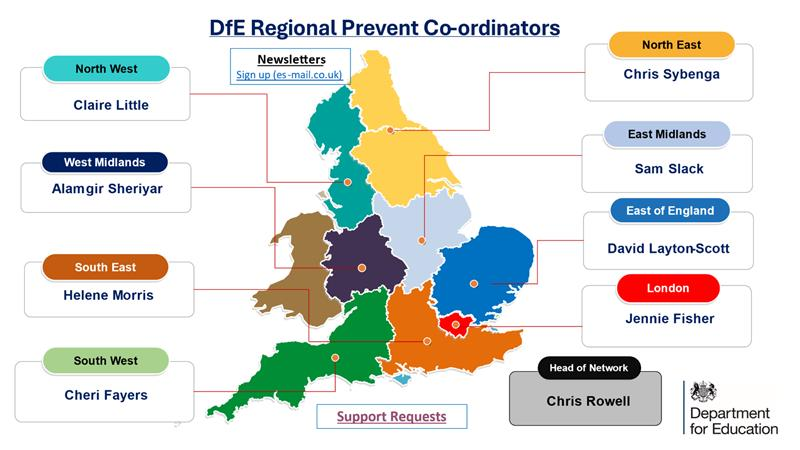
Regional Prevent Coordinators
The refocused Prevent strategy recommended the appointment of regional coordinators to facilitate engagement between different organisations at a local level. Contact details for each regional coordinator can be found below. The coordinators provide information on the Prevent strategy, details of training courses related to Prevent (such as Workshop to Raise Awareness of Prevent - WRAP) and links to relevant stakeholders in each region including the local authority.
Please note this list changes regularly and was up to date as of October 2024
| Home Area | Under 18’s | Adults at Risk |
| October 2024 |
Regional Leads Regional Prevent education coordinators - GOV.UK |
|
| PREVENT East of England |
David Layton-Scott [email protected] 07713 764564 |
David Layton-Scott [email protected] 07713 764564 |
| PREVENT East Midlands |
Sam Slack [email protected] 07384 452156 |
Sam Slack [email protected] 07384 452156 |
| PREVENT Northeast |
Chris Sybenga [email protected] |
Chris Sybenga [email protected] |
| PREVENT Northwest |
Claire Little [email protected] |
Claire Little [email protected] |
| PREVENT Southeast |
Helene Morris [email protected] Mobile: 07901 384401 T: 0204 566 6324 |
Helene Morris [email protected] Mobile: 07901 384401 T: 0204 566 6324 |
| PREVENT Southwest |
Cheri Fayers [email protected] |
Cheri Fayers [email protected] |
| PREVENT West Midlands |
Alamgir Sheriyar [email protected] |
Alamgir Sheriyar [email protected] |
| PREVENT London |
Jennie Fisher [email protected] Mobile: 07880 469588 |
Jennie Fisher [email protected] Mobile: 07880 469588 |
| Counter Terrorism Hotline Only use if imminent threat | 0800 789321 or 999 | 0800 789321 or 999 |
| London Borough Merton |
Reporting abuse or safeguarding adults Emergencies If the adult is in immediate danger call 999 Non-Emergencies Reporting to adult social care department Referral form https://www.merton.gov.uk/system/files/safeguarding_adults_enquiry_referral_form.doc First response team call 020 8545 4388 (9.00am to 1.30pm) Crisis line call 07903 235 382 (1.30 to 5.00 - not weekends) Emergency Duty Team (out of hours after 5.00) Call 020 8770 5000 or 0345 6189762 |
|
| Surrey Local Authority |
Local Authority Designated Officer (LADO) Children and young people Call 0300 123 1650 [email protected] |
Adults Safeguarding Make a safeguarding referral Call 0300 200 1005 |
| Devon Local Authority |
You can report your concerns by; • calling Adult Social Care on 0345 1551 007 (Mon to Thurs 9am – 5pm, Friday 9am – 4:30pm and Saturday 9am – 5pm) • Outside of the hours above or on bank holidays call the Emergency Duty Service on 0345 6000 388. https://www.devon.gov.uk/adult-social-care/safeguarding/ |
|
| Lancashire Local Authority |
If abuse has taken place in Blackpool or Blackburn with Darwen Areas, please call; Blackpool 01253 477592 Blackburn with Darwen 01245 585949 |
|
| South Yorkshire |
Barnsley Customer Access Team (Members of the Public) 01226 773 300 https://www.barnsley.gov.uk/search?search=safeguarding+adults+concern+form Doncaster Safeguarding Adults Contact Team 01302 737 391 (Option 3 for Safeguarding) https://www.doncaster.gov.uk/services/adult-social-care/safeguarding-adults-contents-page Rotherham Metropolitan Borough Council 01709 822 330 https://www.rotherham.gov.uk/info/200593/social_care_and_support/408/get_help_for_someone_being_abused_or_neglected Sheffield City Council First Contact 0114 273 4908 https://www.sheffieldasp.org.uk/sasp/sasp/for-professionals/professionals-report-an-adult-safeguarding-concern |
|
| Liverpool |
How to report a concern If you suspect an adult with care and support needs may be at risk of abuse or neglect, please use the report an adult at risk form on liverpool.gov.uk. If you need to report an urgent safeguarding concern and believe that an individual is at serious risk of harm which will require a response within 48 hours, please call 0151 233 3800. |
|
| North Tyneside |
If you are worried about the safety or welfare of an adult in North Tyneside, please tell us straight away. You can call us in confidence on (0191) 643 2777 (office hours) or 0330 333 7475 (evenings and weekends). |
|
Support Agencies
Construction Helpline Ltd will identify External support agencies on a case-by-case basis as and when required. This will be carried out by our Designated Person for Safeguarding and Prevent: Safeguarding Lead Umer Mansoor.
Email: [email protected]
Telephone: 0207 199 9800
Sources of information for work-based learning providers (links checked 22/10/2024)
Appendices
Appendix 1 - Understanding Safeguarding
Appendix 2 - Understanding Prevent
Appendix 3 - Safer Recruitment
Appendix 4 - Staff Code Of Conduct
Appendix 5 - Computer Safety Policy
Appendix 6 - Safeguarding Risk Assessment (Separate Document)
Appendix 7 - Referral Process diagram
Appendix 8 - Safeguarding Register (DBS)
Note: (Being updated) CHL is currently involved a couple of tenders requiring updated policies and a decision was taken by the management team to update the policies required for submission to reflect the structural changes that have taken place over the previous year.
Appendix 1
Understanding Safeguarding
What is Safeguarding?
Safeguarding is a proactive process of protecting and ensuring the safety and well-being of young and vulnerable learners.
Safeguarding may involve instances in which a young or vulnerable learner is suffering or likely to suffer harm.
Safeguarding involves adopting safer recruitment practices to assist in identifying persons who are unsuitable to work with young or vulnerable learners.
What are the benefits of effective Safeguarding?
When learners feel safe and secure, they can concentrate on learning. Learners can rely on those people in positions of trust.
Staff are protected from malicious and misplaced allegations.
Staff are clear about individual responsibilities, roles, and boundaries.
Learners are appropriately protected, and all issues are dealt with effectively.
Definitions and types of Abuse or Neglect
This section closely reflects the procedures and guidance in the Liverpool Safeguarding Children’s Board and the Home Office document “working together to safeguard children”.
“Child abuse and neglect” is a generic term encompassing all ill treatment of young and adult at risk learners, including serious physical and sexual abuse and sexual assaults as well as cases where the standard of care does not adequately support the person’s health or development.
Abuse and neglect are forms of maltreatment of a young or adult at risk learner.
Somebody may abuse a young or vulnerable learner by inflicting harm, or by failing to prevent harm.
Young or vulnerable learners may be abused in the family or an institution or community setting by those known to them or, more rarely by a stranger. An adult or adults or another child or children may abuse them.
Working together to safeguard children (2010) sets out definitions and examples of the four broad categories of abuse:
Physical Abuse
Physical abuse may involve hitting, shaking, throwing, poisoning, burning, or scalding, drowning, suffocating or otherwise causing physical harm. Physical harm may also be caused when a parent or carer fabricates the symptoms of, or deliberately causes illness.
Emotional Abuse
Emotional abuse is the persistent emotional maltreatment of a person such as to cause severe and persistent adverse effects on their development. It may involve conveying to the person that they are worthless or unloved, inadequate, or valued only in so far as they meet the needs of another person. It may feature age or developmentally inappropriate expectations being imposed on them.
These may include interactions that are beyond the person’s developmental capacity, causing the person frequently to feel frightened or in danger, or the exploitation or corruption of persons. Some level of emotional abuse is involved in all maltreatment of a person, though it may occur alone.
Sexual Abuse
Sexual abuse involves forcing or enticing a person to take part in sexual activities, including prostitution, whether or not the person is aware of what is happening. The activities may involve physical contact, including penetrative or non-penetrative acts. They may include non-contact activities, such as involving them in looking at, or in the production of pornographic material or watching sexual activities or encouraging sexually inappropriate behaviour.
Neglect
Neglect involves the persistent failure to meet a person’s basic physical and/or physiological needs, likely to result in the serious impairment of the person’s health and development. Neglect may occur during pregnancy as a result of maternal substance abuse. Once a child is born, neglect may involve a parent or carer failing to provide adequate food and clothing, shelter including exclusion from home or abandonment, failing to protect a person from physical harm or danger, failure to ensure adequate supervision including the use of inadequate care takers, or the failure to ensure access to appropriate medical care or treatment. It may also include neglect of, or unresponsiveness to, a person’s basic emotional needs.
Additional types of abuse and unsafe activities which we recognise, and which have become more prevalent in recent times are:
Signs and indicators of possible Abuse
When considering whether there is enough information and evidence to suggest a young or vulnerable learner has been abused, there are a number of possible indicators. However, there may be a perfectly reasonable explanation, so it is important to remain vigilant but not be overzealous nor jump to conclusions.
There may also be no signs or indicators of abuse; however, this does not necessarily mean a report of abuse is false.
Signs suggesting physical abuse
Signs of sexual abuse
Signs suggesting emotional abuse
Appendix 2
Understanding Prevent
Background
PREVENT is part of the Home Office and the Police counter-terrorism strategy and aims to stop people from becoming terrorists or supporting terrorism by working with individuals and communities to address issues before they become a criminal matter to stop people moving from extremism into terrorist-related activity.
Context
Young people in the UK are potentially vulnerable to engagement with extremist ideologies or to targeting by extremist organisations. Colleges, and other organisations that interact with young people, should be aware of these risks and be familiar with the support networks and processes in place to protect vulnerable individuals from becoming radicalised or drawn into terrorism.
Definition of Radicalisation
The Institute of Strategic Dialogue defines radicalisation as “the process through which an individual changes from passiveness or activism to become more revolutionary, militant or extremist, especially where there is intent towards, or support for, violence.” Driving factors behind radicalisation can include Lack of integration and/or polarisation Identity crises and/or isolation Political and/or democratic disenfranchisement Discrimination Foreign policy and/or international crises or disputes Political movements Ideologies and/or faiths
Who are we safeguarding from Radicalisation?
There is no stereotype for people who hold extremist views. Vulnerability, isolation, and personal grievances added to strong political, religious, or social views, can result in a person searching for a cause. People can become vulnerable for many reasons including:
We are by no means suggesting that one or all of these characteristics or circumstances will drive someone to terrorism. But they often lead to a sense of injustice – be that on a personal or more far-reaching scale. Their vulnerabilities or susceptibilities are then exploited towards crime or terrorism by people who have their own agenda.
There is no typical gender, age, religion, or background that extremists will target but they use a sense of “Duty” (belonging to a specific group), “Status” (need for reputation) and “Spiritual Rewards” (test of faith) as a way of drawing them in.
This raises the question of what those signs of radicalisation will look like: They will look a lot like troubling behaviour:
Emotional – angry, mood swings, new found arrogance
Verbal – expressing opinions that are at odds with generally shared values
Physical – appearance (tattoos), change in routine
Appendix 3
Safer Recruitment
Construction Helpline Ltd will take all possible steps to prevent unsuitable persons working with young or vulnerable learners and in doing so will follow the good practice contained within the legislative document Safeguarding Children and Safer Recruitment in Education (2007), Safer Practice, Safer Learning document produced by NIACE and Prevent Duty Guidance 2015
When interviewing potential staff, we will ensure that:
Where a position requires an Enhanced DBS check this will be made clear on the job advert and applicant form and a statement explaining The Independent Windscreen Academy’s commitment to Safeguarding / Prevent will be documented. All applicants will complete an application form enabling each of them to have the same opportunity to provide information about themselves and assist in identifying any gaps in their employment history.
During Interview the panel will explore:
A single central register (SCR) of DBS numbers and mandatory training will be held for all staff employed and any associate staff/contractors by Construction Helpline Ltd and this will be updated on a regular basis.
Post appointment
All staff will take part in an induction programme which will vary dependent on the nature of the role. The purpose of this to be:
Probation Periods
All staff employed by Construction Helpline Ltd will be subject to a Probationary Period of either six months or twelve months before being allocated a permanent appointment/fixed term contract. To provide suitable support for each member of staff and an opportunity to seek support and clarification in their role. A number of action planning /review meetings will take place at 2 weeks, 1 month, 3 months, 6 months, and 12 months before final confirmation of employment is given.
If for any reason the member of staff is found not suitable for permanent employment, then the concerns and remedial actions documented at reviews will be used as a basis for dismissal
Appendix 4
Staff Code of Conduct
The code of conduct should guide all actions taken by staff and anyone else working on behalf of Construction Helpline Ltd. If it is necessary to act contrary to it (for example visiting a learner in the home) you should only do so after discussion and approval with your line manager.
The focus of your relationship with any learner you have through the course of your work should always remain professional and you should always act in a professional manner. You should never develop a personal relationship, and you should avoid socialising with learners on occasions where it does not constitute part of your normal duties and avoid establishing relationships through the use of social media such as Twitter or Facebook
It is essential to have guidelines to follow to minimise the possibility for abuse, misunderstanding and misinterpretation. False examples will help create a positive, transparent culture and climate.
All employees should be aware of the potential for misunderstanding when touching or coming into contact with young or vulnerable learners.
If it is an accepted part of a course, touching should be appropriate to the situation and if applicable all relevant guidelines should be followed. Consoling a young or vulnerable learner who is upset and administering first aid are examples of necessary and acceptable behaviour.
Employees should, however, endeavour to minimise any possible misunderstanding of their actions.
Safeguarding staff
All learner applications are checked to raise any disclosures which may flag up a Safeguarding risk. If previous concerns about a learner are disclosed a risk assessment must be taken. Relevant risk assessments will then take place. All files will then be held centrally, in a locked room and locked safety cabinet.
All files of learners disclosing information which is deemed to be a concern MUST BE PASSED onto the lead designated safeguarding person. If a learner is deemed a significant risk to other students or staff this will be raised immediately.
During the enrolment of new learners, if staff are made aware of additional information which is considered to be a safeguarding risk this information must also be passed on immediately to the DSO.
External Speakers and Events Policy, Trips/visits, and Work Placements
Construction Helpline Ltd recognises that there will be times when staff and learners will be exposed to the views of external speakers either invited into deliver training or through external events. Through the Prevent Risk assessment and this External Speakers and Events Policy it aims to eradicate or minimise the risk of learners being exposed to extremist ideas in order to protect the welfare of staff and learners.
Any decision to invite an external speaker into the Construction Helpline Ltd to deliver a guest presentation or to host/attend an event will be officially proposed through the CEO and will consider the following:
Construction Helpline Ltd has most of its learners in the workplace involved in offsite activities. These fall broadly into two areas:
Trips/Visits off campus
Trips / visits must be carefully planned, and staff must have parental consent forms for all young people and vulnerable adults. They must be risk assessed, and students’ vulnerabilities considered.
Work based Learning and Work Experience
We ensure that all learners who are placed with employers and are working or learning offsite are in appropriate settings
Appendix 5
Computer Safety Policy
Vulnerable individuals may suffer abuse or be exploited in many ways by abusers and radicalisers. This could be through direct face to face contact, or indirectly through the internet, social networking, or other media.
Access to extremist material is often through leaflets and local contacts. However, the internet plays an important role in the communication of extremist views. It provides a platform for extremists to promote their cause and encourage debate through websites, internet forums and social networking. It is a swift and effective mechanism for disseminating propaganda material and is not always possible to regulate.
Likewise airing one’s views and ideas on social media or even just posting a picture can lead to abusive replies, attempts to groom individuals to post other images etc. These are all forms of abuse and staff need to look out for signs that a learner may be being abused.
Staff at Construction Helpline Ltd should be aware of anyone making frequent visits to websites showing images such as armed conflict around the world and providing speeches and access to material from those involved in the radicalising process.
It is the responsibility of all staff to ensure that they are following the current version of the Safeguarding / PREVENT Policy.
A dedicated website to report online content that may be illegal is available at www.direct.gov.uk/en/CrimeJusticeAndTheLaw/Counterterrorism/DG_183993
Appendix 6
Safeguarding/Prevent Risk Assessment – separate document
Appendix 7
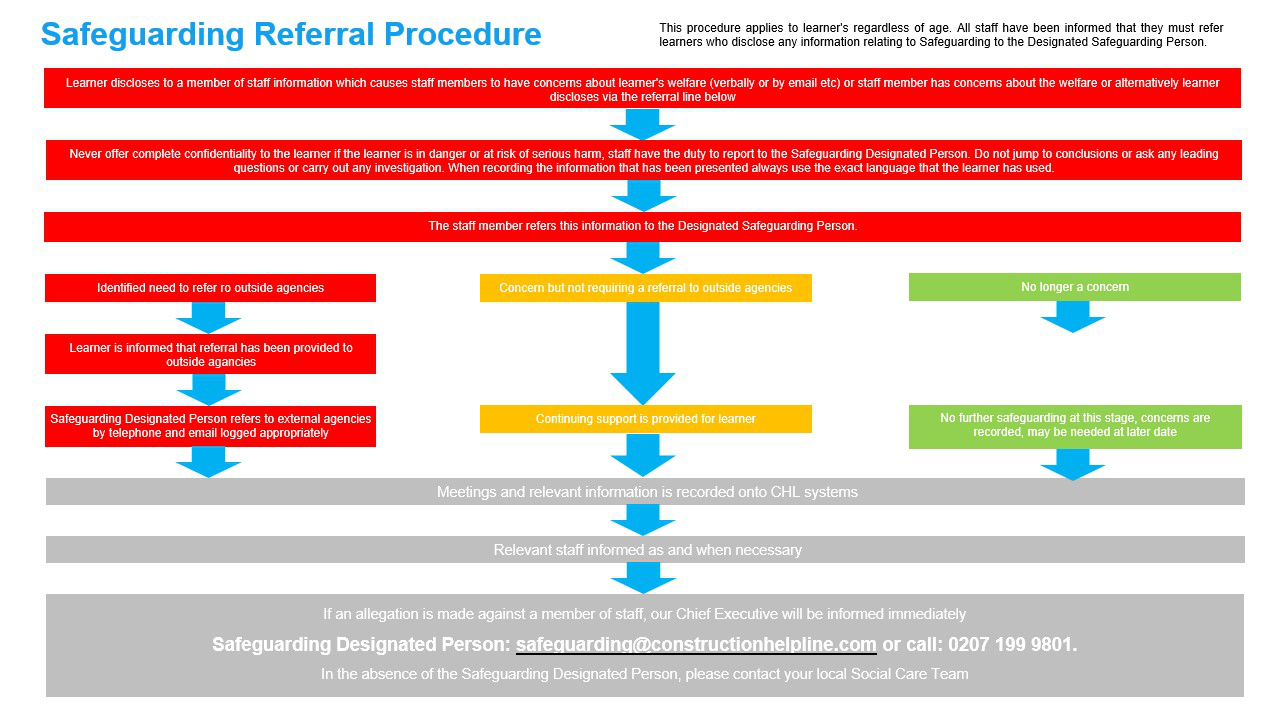
Referral Process diagram
Appendix 8
Single Central Register (DBS)
Disclosure and Barring Service (DBS) Check List and Record kept with HR team at CHL:
Before commencing work check:
✓ Name and DOB is as seen on identification.
✓ Date issue is within last 3 years.
✓ If going to be working directly with children, young people or vulnerable adults, an Enhanced Certificate is required.
✓ It is the original document.
✓ It is clear of convictions, cautions etc.
EXAMPLE – please see original document held by Head of Quality Operations
|
Name: |
Job Title/Role: |
DBS Certificate Number: |
Date Seen: |
Date of Issue: |
Type Standard/Enhanced: |
Signed off By Manager: |

© Copyright 2010 - 2026 constructionhelpline.com All Rights Reserved